

The Axiom Ayn Rand Stole
A is A because I AM is I AM: postmodernism, the church, and the only consistent objectivism.

A = A.
Once, even pagan philosophers knew this (see Ayn Rand and her philosophy, “Objectivism”).
She was right… in part, at least.
Objective truth does exist. Even if she didn’t know the source, the cause, or the Creator of why it does.
Yet all Christians, the true “remnant, chosen by grace” (Rom. 11:5) – should inherently be objectivists. If you are a follower of the one true Christ, I aim to show you why you are, in fact, a Christian objectivist.
(Yes, there are false “christians” who have been deceived by false christs and counterfeit gospels that use the same language in order to deceive (see Matt. 7:21–23; 2 Cor. 11:3–4, 13–15). Whom exactly the true children of God are, is not the point. As Spurgeon noted, God didn’t mark the elect with a yellow stripe down their backs.[1] If you know yourself to be a sinner, then repent and come to Him — “whoever comes to me I will never cast out” (John 6:37; cf. 1 Tim. 1:15; Luke 3:8; Matt. 3:8; Mark 1:15).)
By Rand’s definition, reality “exists as an objective absolute — facts are facts, independent of man’s feelings, wishes, hopes or fears.”[2] And truth, she said, “is the recognition of reality.”[3]
That is true. And all followers of Christ should presume as much.
You can deny that gravity exists all you want. Jump off the Empire State Building and see how that works out for you.
The question is whose reality are we living in? Who created it? Who defined it? Who set the facts? Who makes the rules?
Unfortunately, and to Satan’s — the deceiver, the god of this world (2 Cor. 4:4) — delight, we live in a thoroughly postmodern America.
Origin
Postmodernism has been defined as the refusal to accept any overarching, universal account of truth, reason, history, or morality.[4] As well as that truth is not discovered but constructed — by cultures, communities, and language.[5]
The loose idea of postmodernism began in the intellectual and literary criticism (e.g.: “the book means what you think it means, not what the author meant”) circles of the French in the 1960s. Nietzsche was likely the true original fountainhead: “there are no facts, only interpretations.”[6]
Spread through American education
Their teaching will spread like gangrene… (2 Tim. 2:17)
This school of thought began to spread through the American education system in the 1960s. By the mid-1970s (the “Yale School” of deconstruction),[7] this was the predominant method of English departments in prestigious universities. In the 80s, this virus had already spread as theory to history, law, and all other schools of advanced education. And by the early 90s, the idea that “students construct their own knowledge”[8] had already become orthodoxy in the K-12 educational system of America.
Fast forward to today (2026), this isn’t even a labeled school of thought, it’s just the default assumption. The culture. The modus operandi. Do you know of anyone who self-identifies as a “postmodernist”? We’ll look at what the data says. And it is damning.
But its fundamental premise and central tenets – that you can have “your truth” and I can have “my truth”, and that assertions of an objective and universal moral truth are acts of aggression – are now the unexamined default of our culture.
It has passed from mere theory to unaware assumption. Individualism has become the water that everyone swims in.[9]
Theological Liberalism > Subjectivism > Postmodernism
“Indeed the safest road to Hell is the gradual one.”[10] - C.S. Lewis
Ernest Hemingway’s 1926 novel The Sun Also Rises, describes the process of bankruptcy as “gradually, then suddenly”.[11] So it goes with spiritual bankruptcy, apparently.
The same root, the same disease, the same fundamental premise of postmodernism in America did not begin in the ‘60s. This has been nearly three centuries in the making.
In his final “Farewell Sermon” of 1750 (The very end of the First Great Awakening), Jonathan Edwards prophetically warned of this slippery slope. Initially, He saw the process had started during the Great Awakening with the acceptance by these new churches in New England of the denial of the orthodox position of original sin — the very error the Synod of Dort condemned as an attempt to “bring again out of hell the Pelagian error”.[12] He ultimately would be proved correct in the decades to come with the slide of these very same churches which ultimately led from Orthodoxy to Arminianism to Unitarianism to Universalism.
“Another thing that vastly concerns the future prosperity of the town, is, that you should watch against the encroachments of error; and particularly Arminianism, and doctrines of like tendency. You were, many of you, as I well remember, much alarmed with the apprehension of the danger of the prevailing of these corrupt principles, near sixteen years ago. But the danger then was small in comparison of what appears now. These doctrines at this day are much more prevalent than they were then. The progress they have made in the land, within this seven years, seems to have been vastly greater than at any time in the like space before. And they are still prevailing and creeping into almost all parts of the land, threatening the utter ruin of the credit of those doctrines which are the peculiar glory of the gospel, and the interests of vital piety.”[13]
And then he lands the prediction, notice the generational framing:
“And if these principles should greatly prevail in this town, as they very lately have done in another large town I could name, formerly greatly noted for religion, for a long time, it will threaten the spiritual and eternal ruin of this people, in the present and future generations.”[14]
“This town” he speaks of: Boston. Exactly where Charles Chauncy ministered The First Church of Boston. Within only two generations, The First Church of Boston itself became Unitarian (Not Biblical Christianity). Jonathan Edwards biographer, Iain Murray, notes: “In the progress of the decline which Edwards had rightly anticipated, those Congregational churches of New England which had embraced Arminianism after the Great Awakening gradually moved into Unitarianism and universalism, led by Charles Chauncy.”[15]
Edwards’s diagnosis of why this drift occurs:
“These (Arminianism) principles are exceeding taking with corrupt nature, and what young people, at least such as have not their hearts established with grace, are easily led away with.”[16]
Translation: false doctrine flatters the flesh, and man does not drift toward doctrines that humble him.
Paul already gave the diagnosis: men “by their unrighteousness suppress the truth” (Rom. 1:18); they “exchanged the truth about God for a lie” (Rom. 1:25). Unbelief is not an intellectual deficiency. It is a moral appetite.
Roughly 100 years later, during the Second Great Awakening, these teachings of religious individualism were further proliferated by Charles Finney. By 1893, Charles Briggs was suspended from ministry for teaching, among other heresy, that Scripture contains errors (is not objectively true).[17]
By 1923, J. Gresham Machen rightly identified the prince of the power of the air (Eph. 2:20). This was not a variant of Christianity at all. This was another religion altogether that uses Christian words. Hijacked and counterfeit terms built on a different foundation.[18]
In 1937, H. Richard Niebuhr defined theological liberalism as the idea that “a God without wrath brought men without sin into a kingdom without judgment through the ministrations of a Christ without a cross.”[19] This had become the spirit of the age.
From there, the subjectivism that grew across the West – and which Rand stood against in the 1950s — was simply the next deduction that this epistemology requires: The self is the final authority. Therefore, “truth” is whatever the self experiences or constructs.
Postmodernism is the logical conclusion. The terminal stage of this cancer. Autonomy grown honest about itself and the quiet part said out loud. When the individual mind is sovereign, and sovereign minds disagree, no universal truth can survive. There simply is no universal, objective, truth. Just mine and yours.
Same root, three fruits.
A is A – and the A here is the same lie the serpent has told since the beginning. Declaring that “you will be like God, knowing good and evil” (Gen. 3:5).
But this blade cuts both ways, and here it must turn on Rand herself. She asserted that A is A — but on her own premises, she cannot tell you why A stays A forever. Why does reality still hold tomorrow? Why is nature uniform, so that inductive reasoning exists or works at all? Her system has no answer. She stood on borrowed ground. The Christian is provided the answer from our covenantal God: “While the earth remains, seedtime and harvest, cold and heat, summer and winter, day and night, shall not cease” (Gen. 8:22). The laws of nature are not self-originating. They are not self-sufficient and they are not independent of any outside cause. They are the result of the faithfulness of a covenant-keeping God who “does not change” (Mal. 3:6), with whom there is “no variation or shadow due to change” (James 1:17). Rand’s axiom is a signature she refused to read. A is A because I AM is I AM.
The current state of affairs. What the data says today.
Recent studies of the general American population are damning. According to a 2025 study by the American WorldView Inventory (AWVI) from the Cultural Research Center:
· 66% of American adults reject or doubt the existence of absolute moral truth.
· 74% of adults trust feelings over facts to discern moral truth.
· 90% embrace syncretism (the blending of competing worldviews).
· 67% of Americans agreed that “a mature human accepts different truth views to be just as valid as their own views.”[20]
Modern western culture now affirms what the academics only 60 years ago once proposed as a philosophy. Or what Scripture recorded three thousand years ago: “Everyone did what was right in his own eyes” (Judg. 21:25).
But that is the general population. What about the church? Surely, we have fared far better. After all, were we not warned?
Do not be conformed to this world, but be transformed by the renewal of your mind, that by testing you may discern what is the will of God, what is good and acceptable and perfect (Rom. 12:2)
…following the course of this world, following the prince of the power of the air, the spirit that is now at work in the sons of disobedience (Eph. 2:1–3)
You adulterous people! Do you not know that friendship with the world is enmity with God? Therefore whoever wishes to be a friend of the world makes himself an enemy of God. (James 4:4)
Yet, sadly, the data is an indictment.
The same AWVI study surveyed people who attend evangelical churches. Churches who, by definition (supposedly, at least), believe that the Bible is the Word of God and therefore all that it says is both reliable and true:
54% accept differing views of moral truth as equally valid.
49% of theologically-identified born-again Christians reject or doubt the existence of absolute moral truth.[21]
In other words, they are just as likely to reject the existence of God as the standard and existence of absolute moral truth as they are to accept it. A statistical coin flip, inside churches committed to Sola Scriptura.
Perhaps the survey’s definition of “evangelical” was too loose?
A 2025 study by Lifeway Research and Ligonier Ministries[22] surveyed Evangelicals who said that they strongly agreed with four statements:
The Bible is the highest authority for what I believe.
It is very important for me personally to encourage non-Christians to trust Jesus Christ as their Savior.
Jesus Christ’s death on the cross is the only sacrifice that could remove the penalty of my sin.
Only those who trust in Jesus Christ alone as their Savior receive God’s free gift of eternal salvation.
Among this group, 53% agree that “everyone sins a little, but most people are good by nature.” 53% think the Holy Spirit is a force and not a personal being. 47% believe God accepts the worship of all religions.[23]
This is not random error. These are directionally consistent errors. This is the subjectivist premise expressed as doctrinal position:
Man as measure, doctrine as preference.
Why it matters
“You ought to say plainly that you do not believe the gospel of Christ. For to believe what you please, and not believe what you please, is to believe yourselves and not the gospel”[24] -Augustine of Hippo
So far, we have learned that over half the Church today has rejected the inerrancy of scripture. “So what?” you say. “They still believe in Christ.”
But which Christ do they believe in? Do they believe in the Jesus of the Bible? The one who said “’I am the way and the truth and the life. No one comes to the Father except through me’” (John 14:6)? Or do they believe in a different “Jesus” altogether? One whom 47% of Christians today say, “accepts the worship of all religions.” Jesus himself declares that “Not everyone who says to me, ‘Lord, Lord,’ will enter the kingdom of heaven… I declare to them, ‘I never knew you; depart from me, you workers of lawlessness.’”[25] In the Parable of the Wedding Banquet, He tells the story of a guest who shows up to the wedding (between Christ and His bride, the Church) not wearing the proper wedding garments and is cast into hell, and concludes: “For many are called, but few are chosen.” [26]
Postmodernism even has a patron saint in the Gospels. “What is truth?” Pilate asked — while Truth incarnate stood before him (John 18:38).
Our theology matters. What we think about God, who He is, and His attributes, has consequences.
God names Himself “I AM WHO I AM” (Exod. 3:14), and gives His people the name YHWH — “He Is” — from the same verb (Exod. 3:15). Based on verb tense, it can also be read “I AM/WILL BE, WHO I AM/WILL BE.” Even His name is not only objective, but always and forever objective.
Bavinck, in his Reformed Dogmatics, insisted that the doctrine of God as absolute, self-existent, and independent (aseity) is the ground of the true religion — that God is “the sole cause of all that exists.“[27]
YHWH is also God’s covenant name. He is in covenant with His people. He is faithful to this covenant, even when we are not. Yet in this covenant, there are both blessings (for obedience) and punishment (for disobedience) - (see Lev. 26; Deut. 11:26–28; 28).
To disbelieve or disobey any word of Scripture is to disbelieve or disobey God.[28] The Westminster divines anchored the authority of Scripture “wholly upon God (who is truth itself) the author thereof”, and not dependent on the interpretation any man (WCF 1.4). Warfield compressed it to five words: what Scripture says, God says.[29]
“The liberals are not faithful to the God of the Bible, the God who is there. Historic Christianity, biblical Christianity, believes that Christianity is not just doctrinal truth, but flaming truth—true to what is there, true to the great final environment, the infinite-personal God. Liberalism, on the other hand, is unfaithfulness; it is spiritual adultery toward the divine Bridegroom. We are involved, therefore, in a matter of loyalty—loyalty not only to the creeds, but to the Scripture, and beyond that to the divine Bridegroom—the infinite-personal divine Bridegroom who is there in an absolute antithesis to his not being there.”[30] - Francis Schaeffer
When we reject truth, we reject the source of all truth: God.
And there are consequences.
“My people are destroyed for lack of knowledge; because you have rejected knowledge, I reject you from being a priest to me. And since you have forgotten the law of your God, I also will forget your children.” (Hosea 4:6)[31]
Bavinck made the case that a theologian is one who does holy work.[32] Our religion is the fear of God. Therefore, poor theology, is not only the lack of the fear of God but is also to profane God’s holy name to claim something He himself has not said, or perhaps worse, said is untrue. If a pure theologian does God’s work, a poor one does the devils.
The Answer
The third question in the Shorter Catechism is the question in which I am interested just now: “What do the Scriptures principally teach?” The answer is: “The Scriptures principally teach, what man is to believe concerning God, and what duty God requires of man.”
The thing that I want you to notice about this answer is that it makes the Scriptures principally teach, first, what man is to believe and, second, what man is to do. It puts truth before conduct, doctrine before life. It makes truth the foundation of conduct and doctrine the foundation of life.
Today the order is commonly reversed. Life comes first, we are told, and doctrine comes afterwards. Religion is first an experience and only secondarily a doctrine….
Such is the attitude that is dominant in the religious world of our day—religion as an experience and doctrine as just the necessarily changing expression of the experience; life first and creed as just the changing expression of it. Those are the shibboleths that designate the prevailing attitude.What shall we think of that attitude? Well, in the first place, I think we ought to face clearly the fact that it is an attitude of the most complete unbelief that could possibly be imagined. It denies not this truth or that but truth itself. It denies that there is any possibility of attaining to a truth which will always be true. There is truth, it holds, for this generation and truth for that generation, but no truth for all generations; there is truth for this race and truth for that race, but no truth for all races.
You do not have to read very far in the Bible in order to get the answer. The answer is given to you in the first verse. Does the Bible begin with exhortation; does it begin with a program of life? No, it begins with a doctrine. “In the beginning God created the heaven and the earth.” That is the foundation doctrine upon which everything else that the Bible says is based.The Bible does present a way of life; it tells men the way in which they ought to live. But always when it does so it grounds that way of life in truth.[33] - J. Gresham Machen
The moment we budge an inch on the inerrancy and authority of Scripture; we have lost our firm foundation. We have invited the inevitable – even if slow and gradual – slide to heresy. We have then become our own arbiter of truth, believing the very first lie: “Did God really say?” (Gen. 3:1)
“People do not drift toward Holiness.”[34] – D.A Carson
The same drift Jonathan Edwards rightly predicted at the institutional level begins first in the individual’s heart. When we reject biblical authority, we become the authority. But we are not God, as much as we’d like to be. We are made in His image, but we can never fully understand the depths of His attributes and greatness (Pss 145:3, Rom. 11:33, Isa. 55:8-9, Job 26:14) He is the immutable God. Our hearts are prone to wonder. Truth tied to the Word and authority of the immutable God never changes. An interpretation of truth tied to the human heart as the authority will drift. It may be the slightest deviation as first, almost unnoticeable. Like two planes leaving from the same departure: only a single degree of difference in their direction will ultimately yield vastly different destinations.
Unless we repent and return to submission to the Word of God as authority over our whole life – the results will be disastrous.
This is why a church which surrenders the authority of Scripture retains nothing worth belonging to.
The Bible not only claims hundreds of times to be the Word of God, it also states that God cannot lie (2 Sam. 7:28, Titus 1:2, Heb. 6:18) and to be the standard of truth (John 17:17).[35]
It is no accident that R.C. Sproul — whose ministry produced the survey data above — helped frame the Chicago Statement on Biblical Inerrancy that confesses it.
How could you believe in a collection of books that claim to be completely true and without error (Num. 23:19, Pss. 12:6; 119:89; Prov. 30:5; Matt. 24:35), while simultaneously holding that they do contain errors? It’s a contradiction in logic. Once you found one lie in a document that claims to be completely true, how could you trust any of it on its own authority? You couldn’t. Every remaining claim would need outside verification — which means you are no longer sitting under the Word. You have seated yourself as judge over it. That is the only logically honest conclusion: you have made yourself the authority.
And the same 2025 survey asked the question directly: 48% of American Christians say that the Bible, “like all sacred writings, contains helpful accounts of ancient myths but is not literally true.” Barely half (49%) will affirm that the Bible is 100% accurate in all that it teaches.[36]
By their own standards (holding to competing contradictions simultaneously), these are not people who can be argued into orthodoxy — not because they are beyond hope (2 Tim. 2:24–26), but because there are no shared premises left to argue from. You cannot reason from a standard with a man who denies the standard; you can only reason about it (Prov. 26:4–5). Any honest conversation on topics of theology between professing Christians should therefore start with one question: Do you believe in the inerrancy and authority of Scripture? If the opposing side answers in the negative, until you can find common ground there, you’re wasting your breath. Scripture is self-authenticating. It, not its reader, is the Supreme Judge. As Calvin said, “Scripture exhibits fully as clear evidence of its own truth as white and black things do of their color…” [37]
Tertullian saw this eighteen centuries ago:
Now this heresy of yours does not receive certain Scriptures; and whichever of them it does receive, it perverts by means of additions and diminutions, for the accomplishment of it own purpose; and such as it does receive, it receives not in their entirety; but even when it does receive any up to a certain point as entire, it nevertheless perverts even these by the contrivance of diverse interpretations. Truth is just as much opposed by an adulteration of its meaning as it is by a corruption of its text. Their vain presumptions must needs refuse to acknowledge the Scriptures whereby they are refuted. They rely on those which they have falsely put together, and which they have selected, because of their ambiguity. Though most skilled in the Scriptures, you will make no progress, when everything which you maintain is denied on the other side, and whatever you deny is (by them) maintained. As for yourself, indeed, you will lose nothing but your breath, and gain nothing but vexation from their blasphemy.[38]
You have heard the diagnosis. You have heard the prognosis if this error continues.
The good news is that it is never too late if there is still breath in your lungs.
If you are among the half of professing Christians who have rejected the whole counsel of God (Acts 20:27): Repent.
“Rend your hearts and not your garments. Return to the Lord your God, for he is gracious and merciful, slow to anger, and abounding in steadfast love” (Joel 2:13).
“Ask for the ancient paths, where the good way is, and walk in it” (Jer. 6:16).
Return to covenant with the God who is faithful — the God who forgot none of His promises even while we forgot His law — and who has pledged to “restore to you the years that the swarming locust has eaten” (Joel 2:25). Hosea warned that rejected knowledge means a rejected people with forgotten children. Joel answers: returned hearts mean restored years.
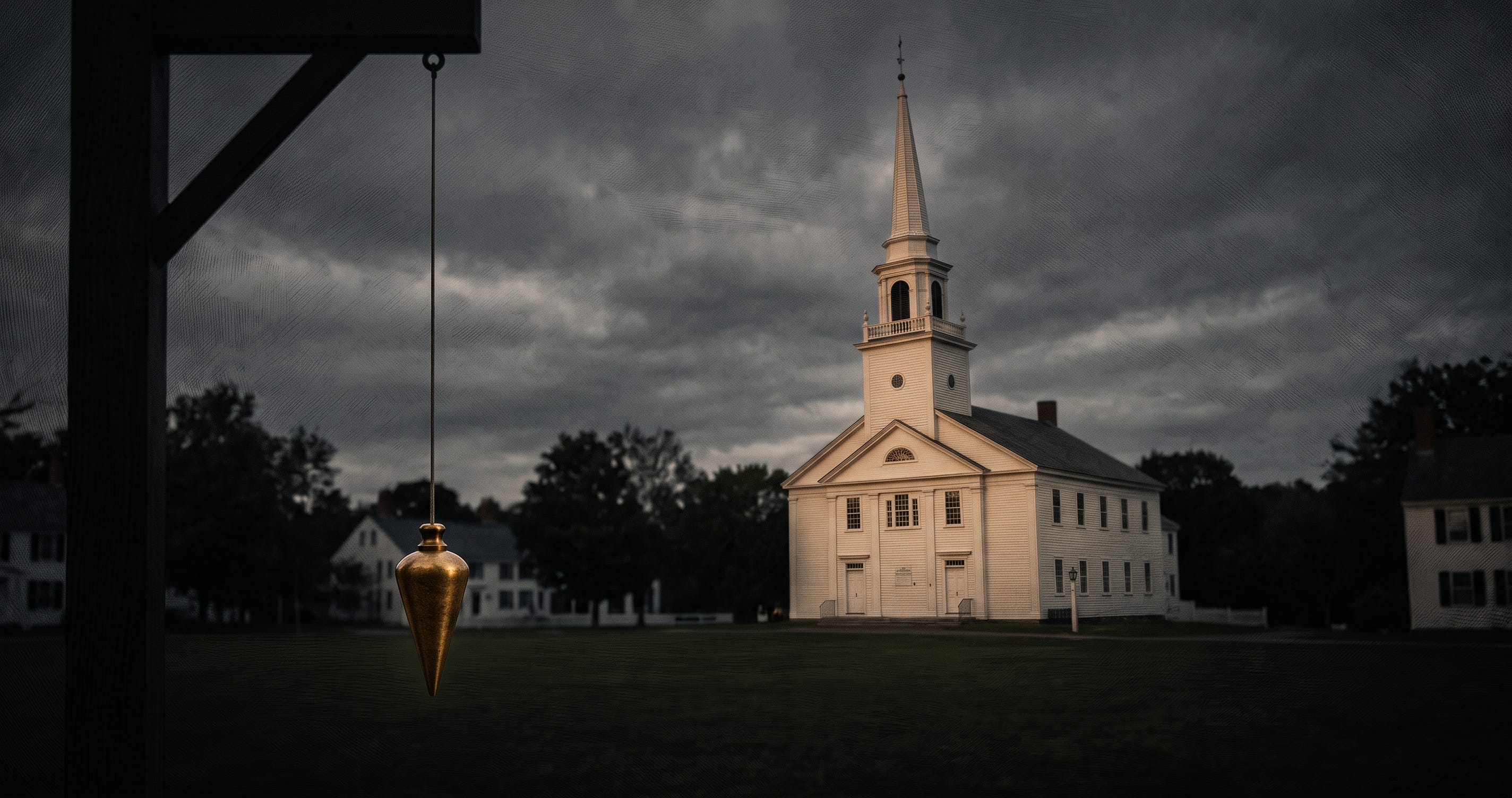
The Plumb Line
This is what he showed me: behold, the Lord was standing beside a wall built with a plumb line, with a plumb line in his hand. And the Lord said to me, “Amos, what do you see?” And I said, “A plumb line.” Then the Lord said,
“Behold, I am setting a plumb line
in the midst of my people Israel;
I will never again pass by them;
the high places of Isaac shall be made desolate,
and the sanctuaries of Israel shall be laid waste,
and I will rise against the house of Jeroboam with the sword.” [39]
A plumb line is a builder’s tool: a weight on a string, pulled by gravity into a perfectly vertical line. It does not consult the builder’s feelings. It does not make peace with error. It is objective because it works through the law of gravity, which is an objective constant that YHWH Himself created in the very first verse (Gen. 1:1, Gen. 8:22). And God says that He Himself sets the plumb line in the midst of His people. He is our standard of truth.
Measured against that line, every one of us is out of true. But the same God who sets the plumb line laid a cornerstone: “Behold, I am the one who has laid as a foundation in Zion, a stone, a tested stone, a precious cornerstone, of a sure foundation… And I will make justice the line, and righteousness the plumb line” (Isa. 28:16–17). Peter tells us the cornerstone’s name (1 Pet. 2:6).
The plumb line still hangs. But beside it stands the stone.
A=A.
Because I AM is I AM.
[1] This saying is widely attributed to Charles Haddon Spurgeon in popular Reformed usage, though it does not appear in this form in his published sermons; it should be treated as a paraphrase of his settled conviction rather than as a quotation. The underlying doctrine—that the identity of the elect is hidden from us, so that the gospel is to be preached indiscriminately to all—is thoroughly Spurgeonic. See C. H. Spurgeon, “Sovereign Grace and Man’s Responsibility,” sermon no. 207, in The New Park Street Pulpit, vol. 4 (London: Passmore and Alabaster, 1858); cf. Westminster Confession of Faith 3.8.
[2] Ayn Rand, “Introducing Objectivism,” The Objectivist Newsletter 1, no. 8 (August 1962): 35; reprinted in The Voice of Reason: Essays in Objectivist Thought, ed. Leonard Peikoff (New York: New American Library, 1989), 3.
[3] Ayn Rand, Atlas Shrugged (New York: Random House, 1957), pt. 3, chap. 7 (Galt’s speech): “Truth is the recognition of reality.”
[4] Jean-François Lyotard, The Postmodern Condition: A Report on Knowledge, trans. Geoff Bennington and Brian Massumi, Theory and History of Literature 10 (Minneapolis: University of Minnesota Press, 1984), xxiv. This summarizes Lyotard’s position rather than reproducing his exact wording; his own formulation defines the postmodern as an incredulity toward metanarratives.
[5] Gene Edward Veith Jr., Postmodern Times: A Christian Guide to Contemporary Thought and Culture, Turning Point Christian Worldview Series (Wheaton, IL: Crossway, 1994). As with the preceding note, this sentence is a summary of Veith’s argument rather than a verbatim quotation.
[6] Friedrich Nietzsche, The Will to Power, ed. Walter Kaufmann, trans. Walter Kaufmann and R. J. Hollingdale (New York: Vintage Books, 1968), §481 (Nachlass 7 [60], 1886–87), 267.
[7] On the Yale School, see Paul de Man, Blindness and Insight: Essays in the Rhetoric of Contemporary Criticism, 2nd ed. (Minneapolis: University of Minnesota Press, 1983); de Man, Allegories of Reading: Figural Language in Rousseau, Nietzsche, Rilke, and Proust (New Haven, CT: Yale University Press, 1979); and J. Hillis Miller, The Ethics of Reading: Kant, de Man, Eliot, Trollope, James, and Benjamin (New York: Columbia University Press, 1987). For a contemporary survey, see Jonathan Culler, On Deconstruction: Theory and Criticism after Structuralism (Ithaca, NY: Cornell University Press, 1982).
[8] Ernst von Glasersfeld, Radical Constructivism: A Way of Knowing and Learning, Studies in Mathematics Education Series 6 (London: Falmer Press, 1995); Jacqueline Grennon Brooks and Martin G. Brooks, In Search of Understanding: The Case for Constructivist Classrooms (Alexandria, VA: Association for Supervision and Curriculum Development, 1993).
[9] Carl R. Trueman, The Rise and Triumph of the Modern Self: Cultural Amnesia, Expressive Individualism, and the Road to Sexual Revolution (Wheaton, IL: Crossway, 2020). Trueman’s term of art is expressive individualism, which he traces from Rousseau through the Romantic poets to Nietzsche, Marx, and Freud.
[10] C. S. Lewis, The Screwtape Letters (London: Geoffrey Bles, 1942), letter 12.
[11] Ernest Hemingway, The Sun Also Rises (New York: Charles Scribner’s Sons, 1926), bk. 2, chap. 13. The novel’s wording is “Gradually and then suddenly,” given as Mike Campbell’s answer to how he went bankrupt.
[12] Canons of Dort (1618–19), Second Head of Doctrine, Rejection of Errors, par. 3, condemning the Remonstrant teaching as that which would “bring again out of hell the Pelagian error.”
[13] Jonathan Edwards, “A Farewell Sermon Preached at the First Precinct in Northampton, after the People’s Publick Rejection of Their Minister . . . June 22, 1750,” in The Works of Jonathan Edwards, ed. Edward Hickman, 2 vols. (1834; repr., Edinburgh: Banner of Truth Trust, 1974), vol. 1. A critical text appears in The Works of Jonathan Edwards, vol. 25, Sermons and Discourses, 1743–1758, ed. Wilson H. Kimnach (New Haven, CT: Yale University Press, 2006).
[14] Edwards, “Farewell Sermon.” Emphasis added.
[15] Iain H. Murray, Jonathan Edwards: A New Biography (Edinburgh: Banner of Truth Trust, 1987), 454.
[16] Edwards, “Farewell Sermon.”
[17] On Finney’s revivalism and the theology underlying it, see Charles G. Finney, Lectures on Revivals of Religion (New York: Leavitt, Lord, 1835), and Finney, Lectures on Systematic Theology (Oberlin, OH: James Steele, 1846); for the classic Reformed critique, see B. B. Warfield, Perfectionism, 2 vols. (New York: Oxford University Press, 1931), vol. 2. On Briggs, see Charles A. Briggs, The Authority of Holy Scripture: An Inaugural Address (New York: Charles Scribner’s Sons, 1891). The Presbyterian General Assembly suspended Briggs from the ministry in 1893. He was ordained to the Episcopal priesthood in 1899.
[18] J. Gresham Machen, Christianity and Liberalism (New York: Macmillan, 1923), esp. chap. 2, “Doctrine.”
[19] H. Richard Niebuhr, The Kingdom of God in America (New York: Harper and Brothers, 1937), 193.
[20] George Barna, “Survey Reveals Significant Shifts in Faith Allegiance and Growing Confusion about Moral Truth,” American Worldview Inventory 2025, Report 5 (Glendale, AZ: Cultural Research Center at Arizona Christian University, May 1, 2025); and Barna, “Americans Possess Contradictory and Unbiblical Views about Moral Truth,” American Worldview Inventory 2025, Report 6 (Glendale, AZ: Cultural Research Center at Arizona Christian University, May 15, 2025), https://www.culturalresearchcenter.com/. Both reports draw on a nationally representative sample of 2,100 U.S. adults surveyed in January 2025. The 66 percent and 74 percent figures appear in Report 5; the 67 percent figure, and the finding that syncretism is the dominant worldview of roughly nine out of ten adults, appear in Report 6.
[21] Barna, “Americans Possess Contradictory and Unbiblical Views about Moral Truth,” Report 6; and Barna, “Survey Reveals Significant Shifts in Faith Allegiance and Growing Confusion about Moral Truth,” Report 5. Among adults who attend an evangelical church, 54 percent accept differing views of moral truth as equally valid (Report 6). Among theologically-identified born-again Christians, 49 percent reject or doubt the existence of absolute moral truth (Report 5).
[22] Ligonier Ministries and Lifeway Research, The State of Theology 2025, accessed July 28, 2026, https://thestateoftheology.com/. The four statements listed are Lifeway Research’s operative definition of evangelical belief.
[23] Ligonier Ministries and Lifeway Research, The State of Theology 2025, key findings, https://thestateoftheology.com/.
[24] Augustine, Reply to Faustus the Manichaean 17.3, in Nicene and Post-Nicene Fathers, First Series, vol. 4, ed. Philip Schaff, trans. Richard Stothert (Buffalo, NY: Christian Literature Publishing, 1887), 235.
[25] Matt. 7:21-23 (ESV). Unless otherwise noted, all Scripture quotations are from The Holy Bible: English Standard Version (Wheaton, IL: Crossway, 2016).
[26] Matt. 22:14 (ESV).
[27] Herman Bavinck, Reformed Dogmatics, vol. 2, God and Creation, ed. John Bolt, trans. John Vriend (Grand Rapids: Baker Academic, 2004), §28, “God’s Independence.” Bavinck prefers the term independence to aseity because it reaches beyond God’s existence to his perfections, his decrees, and his works.
[28] Wayne Grudem, Systematic Theology: An Introduction to Biblical Doctrine (Grand Rapids: Zondervan, 1994), 73, 81. Grudem defines the authority of Scripture in exactly these terms, grounding it in the prior claim that every word of Scripture is God’s own word. Cf. Westminster Confession of Faith 1.4.
[29] B. B. Warfield, “‘It Says:’ ‘Scripture Says:’ ‘God Says,’” in The Inspiration and Authority of the Bible, ed. Samuel G. Craig (Philadelphia: Presbyterian and Reformed, 1948), 299–348.
[30] Francis A. Schaeffer, The Great Evangelical Disaster (Westchester, IL: Crossway, 1984). Emphasis added.
[31] Hos. 4:6 (ESV).
[32] Herman Bavinck, “Religion and Theology” (1902), in Essays on Religion, Science, and Society, ed. John Bolt, trans. Harry Boonstra and Gerrit Sheeres (Grand Rapids: Baker Academic, 2008), 49–105. The piece is Bavinck’s rectoral address at the Free University of Amsterdam, published in Dutch as Godsdienst en godgeleerdheid (Wageningen: Vada, 1902).
[33] J. Gresham Machen, “Life Founded upon Truth,” in The Christian Faith in the Modern World (New York: Macmillan, 1936).
[34] D. A. Carson, For the Love of God: A Daily Companion for Discovering the Riches of God’s Word, vol. 2 (Wheaton, IL: Crossway, 1999), entry for January 23.
[35] Grudem, Systematic Theology, chaps. 4–6. For further reading, see International Council on Biblical Inerrancy, “The Chicago Statement on Biblical Inerrancy” (1978), reprinted in Journal of the Evangelical Theological Society 21, no. 4 (December 1978): 289–96.
[36] Ligonier Ministries and Lifeway Research, The State of Theology 2025, https://thestateoftheology.com/. The survey of 3,001 U.S. adult Evangelicals, conducted January 6–15, 2025, found 48 percent agreeing that the Bible “like all sacred writings, contains helpful accounts of ancient myths but is not literally true,” and 49 percent affirming that the Bible is 100 percent accurate in all that it teaches.
[37] John Calvin, Institutes of the Christian Religion 1.7.2, ed. John T. McNeill, trans. Ford Lewis Battles, Library of Christian Classics 20–21 (Philadelphia: Westminster Press, 1960); cf. 1.7.5 on Scripture as self-authenticated (autopiston). Westminster Confession of Faith 1.10. For the method, see Cornelius Van Til, The Defense of the Faith, 4th ed., ed. K. Scott Oliphint (Phillipsburg, NJ: P&R, 2008).
[38] Tertullian, The Prescription against Heretics 17, in The Ante-Nicene Fathers, vol. 3, ed. Alexander Roberts and James Donaldson (Buffalo, NY: Christian Literature Publishing, 1885), 250–51.
[39] Amos 7:7–9 (ESV).